Or: how a nation turned the hour before dinner into a small, civilised art form and why your Prosecco is about to earn its keep
There is a particular moment, somewhere between six and seven in the evening, when Italy collectively exhales. Shutters come down. Cars are abandoned with the usual flair for creative parking. And in every piazza from Turin to Trieste, people drift toward small tables, order a glass of something bitter, and begin a conversation nobody particularly needs to finish.
This is aperitivo, and calling it “Italian happy hour” is a bit like calling the Sistine Chapel a nicely decorated ceiling. Technically accurate. Spiritually, miles off.
A brief and slightly suspicious history
Italians will tell you the aperitivo is ancient, and as with most things Italian, they are right. The Romans were already at it: something bitter, something small, dinner postponed a while longer. A civilisation built, essentially, on the art of stalling.
The modern version owes everything to two regions and one city that stole the limelight from both.
Piedmont gave us vermouth. The word comes from the German Wermut (wormwood) and the drink began, like so many pleasurable things, as medicine. Then in 1786 a Turin herbalist called Antonio Benedetto Carpano blended Moscato with herbs and spices and produced something that was no longer pretending to be medicinal. The Savoy court took to it. By 1863 two friends named Martini and Rossi had made their own version, and by 1867 it was crossing the Atlantic under a name you may have heard once or twice. And so vermouth slipped its medical moorings and sailed out into the world, propelled by the eternal human preference for pleasure over prescription.
Venice invented the Spritz by accident. Austrian soldiers, occupying the Veneto and raised on beer, found local wine too strong and splashed it with sparkling water. Spritzen, in German, means “to spray.” The Venetians presumably had views. But the name stuck, and in 1919 the Barbieri brothers added a clever little liqueur called Aperol. The rest, as they say, is Instagram.
Venice also gave us the Bellini, invented in 1948 at Harry’s Bar, where Giuseppe Cipriani mixed Prosecco with white peach purée and named it after the Renaissance painter because its colour reminded him of a saint’s robe in one of his paintings. I am not aware of another cocktail inspired by ecclesiastical tailoring, and I consider this a significant cultural loss.
Milan, or: how to win without inventing anything
Milan did not invent the aperitivo. Milan simply decided it would be the city of aperitivo, and with that particular combination of money, marketing, and faintly exhausting self-belief, made it so.
Campari opened his first bar in the Galleria Vittorio Emanuele in 1867. His son Davide was the first Milanese child born inside the Galleria itself, an address so impossibly Milanese it ought to come with a pair of sunglasses.
Then came the 1960s, and the single most important slip of the wrist in cocktail history. At the Bar Basso, the bartender Mirko Stocchetto reached for gin to make a Negroni and picked up sparkling wine instead. Rather than admit the mistake, he served it. Thus the Negroni Sbagliato, the “mistaken Negroni”, entered the world, proving once again that some of civilisation’s greatest achievements are simply errors nobody had the courage to correct.
What it actually is
The aperitivo is not really about the drink, or the food. It is about opening, which is what aperire means in Latin. You open your appetite. You open your evening. You open a chair for someone who wasn’t there ten minutes ago and whose presence requires no explanation. The drinks are bitter and low in alcohol on purpose: the point isn’t to get tipsy, but curious. An Italian will nurse a single Negroni Sbagliato for forty minutes and consider the evening an unqualified success. This is not restraint. This is expertise.
Enter the Prosecco
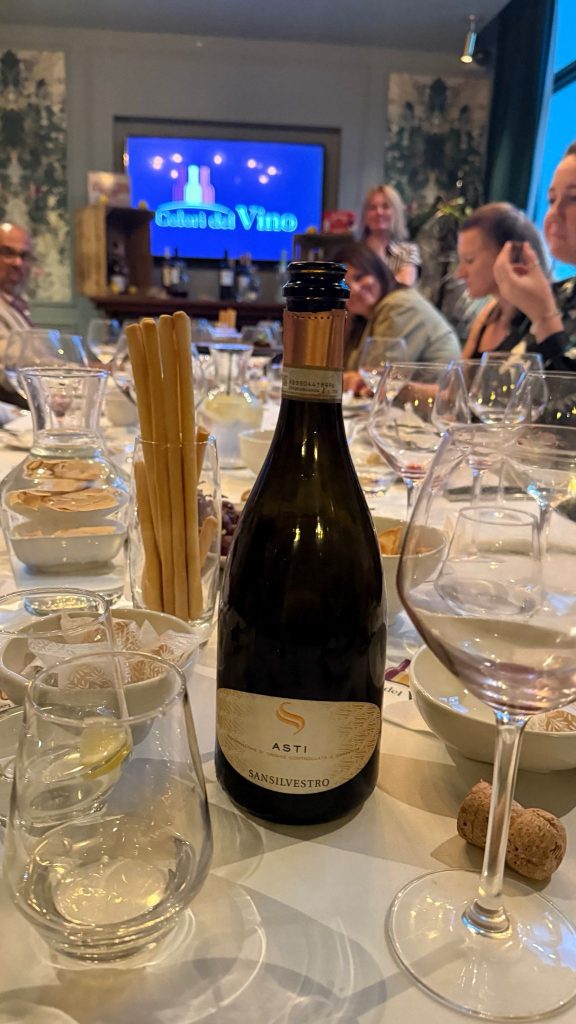
If vermouth built the first act and Campari defined the second, Prosecco has quietly underwritten the third. Cipriani reached for it to make the Bellini. Stocchetto’s famous slip involved a bottle of it. The modern Spritz conquered the world on Glera grapes grown between Conegliano and Valdobbiadene.
Prosecco is the quiet architecture holding much of this up, lighter than Champagne, more forgiving in a cocktail, generous enough to share the stage. A team player, in the best sense. Which is exactly what an aperitivo drink needs to be, since the aperitivo itself is a team sport.
Be the first to know about our events and workshops.